
In short. The protein you eat and the protein you absorb are two different numbers. With severe pancreatic insufficiency, only about half of the protein in food gets digested. Routine blood tests miss this for a long time: albumin and total protein stay normal while the body uses up its own muscle. There is no direct at-home test for protein absorption. It is checked step by step: symptoms, albumin and prealbumin, fecal elastase-1, stool analysis. If a problem turns up, the next steps are a gastroenterologist and, when indicated, enzymes, with weight, grip strength and muscle mass tracked.
Yulia Yusipova, MD, Rector of European University of Longevity and American Academy of Longevity. Updated October 2026.
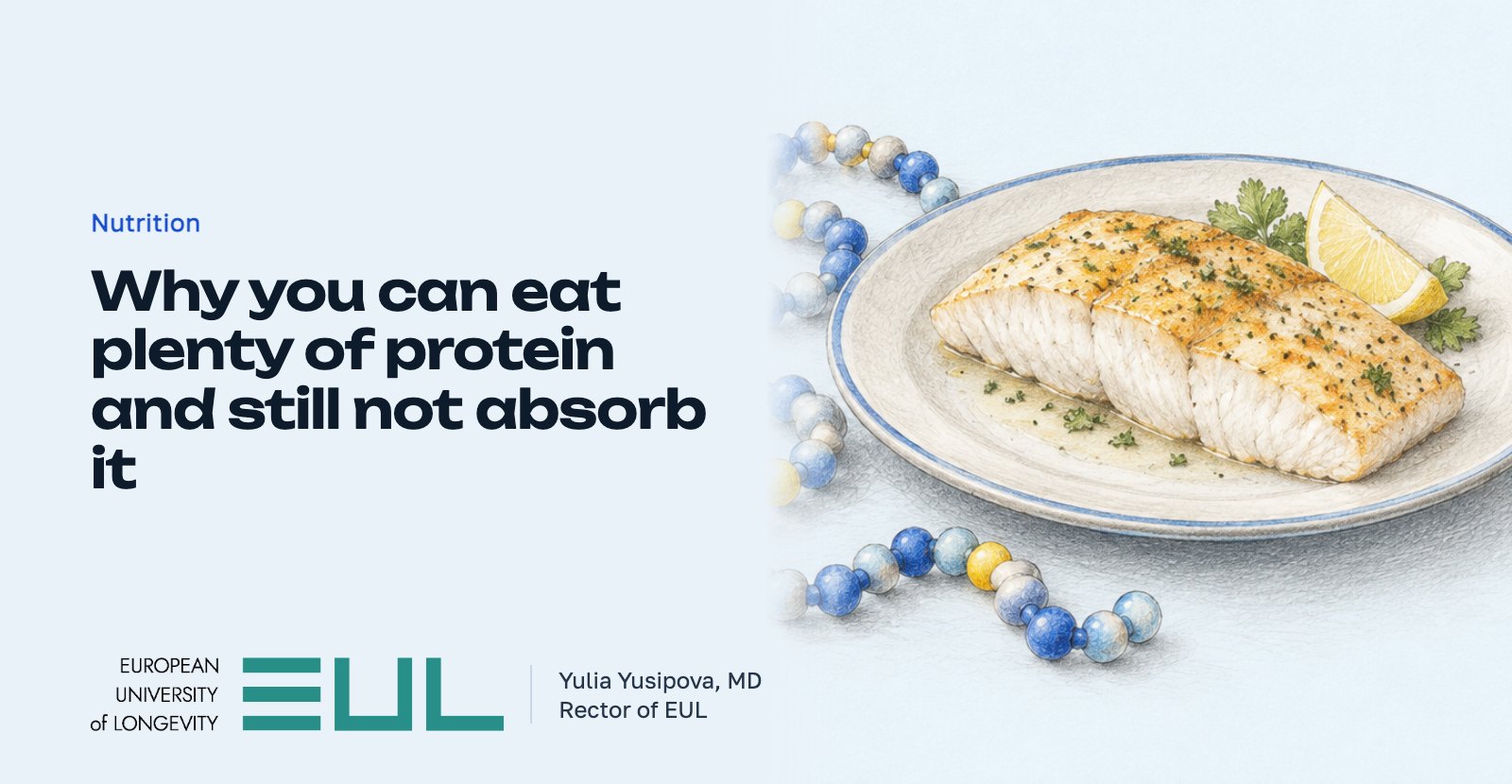
You can eat 150 grams of protein a day and still be protein-deficient at the cellular level. According to stable isotope studies, people with exocrine pancreatic insufficiency absorb only 50% of dietary protein (PMID 24268783), which means half of that carefully weighed chicken breast passes through the gut undigested.
But here is what matters: most standard blood tests will not catch this problem. “Total protein” and even albumin can stay within normal limits while significant malabsorption is going on. The body is remarkably good at maintaining homeostasis, until it can no longer cope.
Can a test show protein absorption?
If you have ever wondered which test shows protein absorption, the answer may disappoint you. In the strict scientific sense, there is no direct at-home test. But there are several levels of assessment, from clinical signs to high-tech research methods.
How do scientists measure how much protein was absorbed?
The current gold standard for measuring true protein digestibility is the dual isotope tracer method, which uses proteins labeled with stable isotopes.
How it works: researchers give participants a test meal with protein “tagged” with these stable (non-radioactive) isotopes. Then, over several hours, they measure how the isotope markers appear in plasma amino acids and in exhaled carbon dioxide.
This makes it possible to calculate:
Ileal digestibility – how much protein was actually digested and absorbed in the small intestine before undigested remnants reached the colon.
Postprandial amino acid kinetics – how quickly and in what amounts amino acids appear in the bloodstream after a meal.
Metabolic utilization – how the body actually uses these amino acids: to build proteins, for energy or for other needs.
Older methods, nitrogen balance (the difference between nitrogen taken in with food and nitrogen lost in urine and stool) and oro-fecal balance, are now considered less accurate. The main problem is that bacteria in the colon actively metabolize undigested protein and distort the results. That is why the focus has shifted to ileal (small intestine) digestibility.
What are PDCAAS and DIAAS, and which protein is absorbed best?
To screen protein sources, as opposed to assessing an individual patient, researchers use in vitro models: lab systems that mimic digestion. Examples are the standardized INFOGEST 2.0 protocol (PMID 30886367) and pH-stat methods. They correlate reasonably well with human data and are used to calculate protein quality scores.
PDCAAS (Protein Digestibility-Corrected Amino Acid Score) is a score that accounts for a protein’s amino acid composition and digestibility. Its maximum value is 1.0.
DIAAS (Digestible Indispensable Amino Acid Score) is a newer and more precise score based on the ileal digestibility of individual essential amino acids. It can exceed 1.0.
This is how we know that whey protein has a DIAAS of about 0.85, egg 1.01, pork 1.17, and pea protein about 0.70 (PMID 33133540). Research papers often give DIAAS as a percentage: 85 means 0.85. These averages come from studies in growing pigs (the digestion model FAO recommends) and use the FAO reference pattern for children aged six months to three years. But they are averages for healthy digestion – your individual absorption can differ substantially depending on the state of your digestive tract.
Which blood tests show protein deficiency?
What can be assessed in real clinical practice
Level 1: Basic lab markers
Albumin is the main transport protein in blood plasma; it is made in the liver. The usual reference range is 35–50 g/L (3.5–5.0 g/dL). A level below 35 g/L (3.5 g/dL) points to a possible protein deficiency.
An important nuance: albumin is a late marker. Its half-life is about 20 days (PMID 31159248), so changes in its level reflect what was happening two to three weeks earlier. By the time albumin drops, the problem is usually already serious.
Prealbumin is a more sensitive marker of protein status, with a half-life of only about 2 days (PMID 31159248). It responds to change faster, both to worsening and to improvement. Reference range: 20–40 mg/dL (200–400 mg/L).
Total serum protein is the sum of all proteins in the blood (albumins plus globulins). The normal range is usually 64–83 g/L (6.4–8.3 g/dL). A low value may point to inadequate intake or protein loss; a high value usually says little about protein status.
Urea (blood urea nitrogen, BUN) and creatinine give an indirect picture of protein metabolism. Urea is the end product of protein breakdown; its level depends both on protein intake and on kidney function.
A major caveat: all of these markers reflect the balance between protein synthesis and breakdown in the body, and they say nothing direct about digestion and absorption. A person with normal albumin can have significant malabsorption: the body compensates by breaking down its own muscles and other tissues to keep blood protein levels up. This is catabolic compensation, and it masks the problem for a while.
How do you check whether the pancreas is digesting protein?
Level 2: Assessing pancreatic and intestinal function
Here we get closer to a real assessment of digestive capacity, that is, how efficiently your digestive tract breaks protein down into amino acids.
Fecal elastase-1 is the main marker of exocrine pancreatic function. Elastase is an enzyme made only by the pancreas, and it is not destroyed as it passes through the gut. So its concentration in stool directly reflects how much the gland secretes (PMID 8944569).
Interpreting the results:
> 200 µg/g – normal, exocrine function preserved
100–200 µg/g – mild to moderate exocrine insufficiency
< 100 µg/g – severe exocrine insufficiency
Why does this matter for protein absorption? In severe exocrine insufficiency, the pancreas does not make enough proteolytic enzymes (trypsin, chymotrypsin, elastase, carboxypeptidases), which break down proteins in the small intestine.
According to isotope tracer studies in patients with cystic fibrosis and chronic pancreatitis, protein digestibility in severe insufficiency falls to about 50% of normal. The good news: it almost normalizes with adequate enzyme replacement therapy (pancreatic enzyme products) (PMID 24268783).
A basic stool analysis (coprogram) can show:
Undigested muscle fibers in the stool. Normally muscle fibers should be fully digested. Finding them points to a shortage of proteolytic enzymes.
Steatorrhea, increased neutral fat in the stool. Although this is a marker of lipase deficiency, it often comes with impaired protein digestion too, because exocrine insufficiency affects all the enzymes.
Increased nitrogen content, an indirect sign of protein loss in the stool.
These markers are less specific than elastase-1, but they are easy to get and part of a standard workup.
Which symptoms suggest protein deficiency?
Level 3: Clinical signs
Sometimes the most valuable assessment needs no lab at all, only careful attention to your own body.
Early signs of impaired protein status:
Slow healing of wounds and cuts – protein is essential for making collagen and other parts of connective tissue. If small cuts take weeks to heal, that is a warning sign.
Nail changes – brittle, peeling nails with lengthwise ridges (onychorrhexis) or transverse Beau’s lines can point to periods of protein deficiency.
Hair changes – thinning, loss of shine, increased shedding. Hair is 90% keratin, a protein that needs amino acids to be made.
Persistent fatigue – not explained by lack of sleep, stress or other obvious causes. Protein is needed to make enzymes, hormones and neurotransmitters, which means practically every process that produces energy.
Late signs (already a serious problem):
Sarcopenia – progressive loss of muscle mass. When protein runs short, the body starts “dismantling” muscle as a source of amino acids for higher-priority needs.
Edema – especially in the legs and ankles. When albumin falls markedly, plasma oncotic pressure drops and fluid moves into the tissues.
Weakened immunity – frequent colds, lingering infections, ordinary respiratory viruses that hit hard. Antibodies and immune cells are proteins, and making them requires amino acids.
How can you tell whether protein or enzymes are working?
A practical approach: how to assess the effect of protein or enzymes
Say you have increased your protein intake or started taking digestive enzymes. How do you know whether it is working?
The ideal research protocol
In clinical studies, protein absorption is assessed like this:
The participant gets a standardized test meal with a known amount and type of protein, for example 25 g of whey protein. Then blood is drawn repeatedly: fasting (baseline), then every 30–60 minutes for 4–5 hours after the meal.
Each sample is tested for individual amino acid concentrations (a full amino acid profile) or at least for essential amino acids and leucine (the main marker of anabolism).
From these data, researchers calculate:
– AUC (area under the curve): the total amount of amino acids that appeared in the blood during the observation period
– Cmax: peak amino acid concentration
– tmax: time to peak
By comparing these values before and after enzymes are started (or between different protein sources), you can assess the effect objectively.
What you can realistically do in clinical practice
Repeated blood draws with an amino acid profile are expensive and not available to everyone. But there are practical alternatives.
Objective measures to track:
Body weight – weigh yourself weekly, at the same time, on an empty stomach, after using the bathroom. With adequate protein intake and absorption, weight should stabilize or rise (if you are deliberately gaining).
Body composition – a DXA scan or bioimpedance analysis monthly or every 2–3 months. Watch the trend in lean body mass as well as total weight.
Grip strength – measured with a hand dynamometer. A simple, inexpensive and informative marker of overall protein status and muscle function. Declining grip strength is an early predictor of sarcopenia.
Strength in training – if you lift weights, track your working weights and reps. With adequate protein nutrition you should see progress, or at least stability.
If you top up your protein with a powder, an unflavored whey protein such as Premier Research Labs Whey Protein is one option, and you can judge the effect by the same four measures.
Where do you start checking protein absorption?
There is no direct at-home test for protein absorption, and that is the first thing to accept. But combining clinical signs, basic lab markers and specific digestive function tests gives a fairly accurate picture for most practical purposes.
My practical algorithm:
Step one – start with symptoms. Do you have signs of protein deficiency? Slow healing, hair and nail problems, constant fatigue, muscle loss?
Step two – basic tests. Albumin, prealbumin, total protein. This is screening: normal values do not rule out a problem, and low values always need attention.
Step three – pancreatic function. Fecal elastase-1.
Step four – stool analysis. Look for undigested muscle fibers, steatorrhea and other signs of maldigestion.
Step five – if problems turn up: see a gastroenterologist, get further testing as indicated, and try enzyme therapy with the effect tracked.
The main takeaway: protein nutrition is far more complex than simply “hitting your grams.” The amount of protein you eat matters, and the amount you actually absorb matters much more. For a large share of people, these two numbers are not the same.
If you eat enough protein and still do not see the results you expect in muscle gain, recovery after training, or the quality of your hair and nails, the problem may be absorption. It is worth checking.
Questions I get asked
Can you eat a lot of protein and still not absorb it?
Yes. With severe pancreatic insufficiency, only about half of the protein from food gets digested, and the rest leaves through the gut. Blood tests stay normal for a long time, because the body takes amino acids from its own muscles.
Which test shows protein absorption?
There is no direct at-home test. Absorption is measured precisely only in research, using protein labeled with stable isotopes. In practice it is assessed in levels: symptoms, albumin and prealbumin, fecal elastase-1 and stool analysis.
Why is albumin normal when protein is short?
Albumin is a late marker: it lasts about 20 days and reflects the situation two to three weeks earlier. While protein is short, the body keeps its level up at the expense of muscle. Prealbumin lasts about 2 days and responds faster.
What does fecal elastase-1 show?
Elastase is made only by the pancreas and is not destroyed in the gut, so its level in stool reflects how the gland is working. Normal is above 200 µg/g. At 100–200 the insufficiency is mild or moderate; below 100 it is severe. In severe insufficiency there are not enough enzymes to break down protein.
How can you tell whether protein or enzymes are working?
Weigh yourself once a week on an empty stomach, check body composition every 1–3 months, measure grip strength with a dynamometer and track your working weights at the gym. Weight and muscle should hold or rise, and strength should not drop. Enzymes are started after testing; discuss them with your doctor.
Sources
- Engelen MPKJ et al. New stable isotope method to measure protein digestibility and response to pancreatic enzyme intake in cystic fibrosis. Clin Nutr, 2014. 19 patients with cystic fibrosis and 8 healthy controls. PMID 24268783
- Brodkorb A et al. INFOGEST static in vitro simulation of gastrointestinal food digestion. Nat Protoc, 2019. PMID 30886367
- Keller U. Nutritional Laboratory Markers in Malnutrition. J Clin Med, 2019. PMID 31159248
- Löser C et al. Faecal elastase 1: a novel, highly sensitive, and specific tubeless pancreatic function test. Gut, 1996. PMID 8944569
- Herreman L et al. Comprehensive overview of the quality of plant- and animal-sourced proteins based on the digestible indispensable amino acid score. Food Sci Nutr, 2020. 17 protein sources, data from studies in growing pigs. PMID 33133540
Thank you for reading Dr. Yulia Yusipova!
Disclosure: Nutrigeek is our store; we earn from purchases made there. These statements have not been evaluated by the Food and Drug Administration. This product is not intended to diagnose, treat, cure, or prevent any disease. This article is for education and does not replace a consultation with your doctor.

Yulia Yusipova, MD
Physician (MD), Rector of European University of Longevity and American Academy of Longevity.