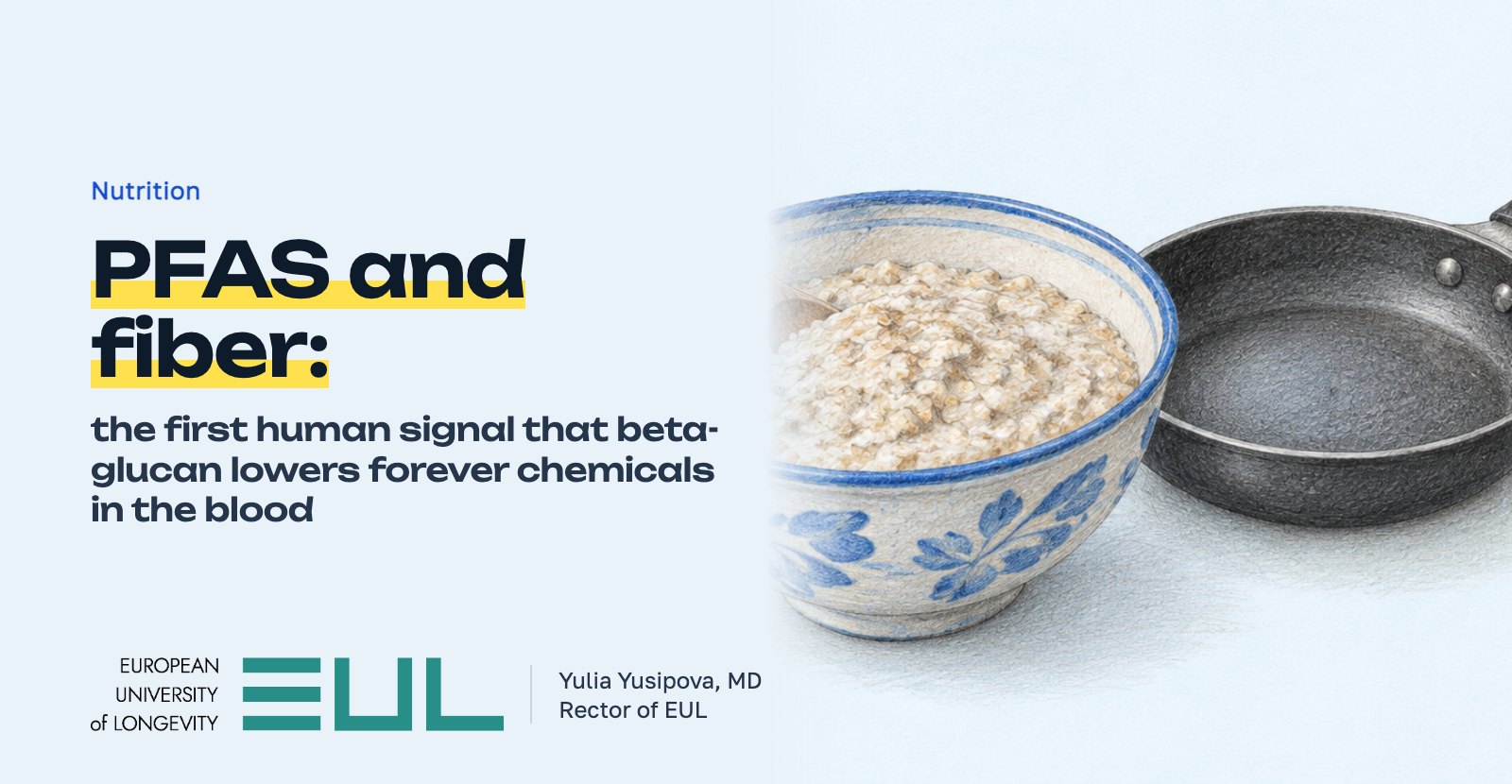
PFAS and fiber: the first human signal that beta-glucan lowers forever chemicals in the blood

In short. PFAS, the “forever chemicals” from nonstick cookware, food packaging and water-repellent coatings, build up in the blood for years: it takes about 5.4 years for half of the PFOS in the blood to clear. In a 2025 pilot study, men who took about 3 grams of oat beta-glucan a day for four weeks saw their long-chain PFAS levels fall, while the comparison group did not. Viscous fiber traps bile acids in the gut, and PFAS travel in a loop together with those bile acids. The data are still limited, so replacing cookware and filtering water come first, and beta-glucan is an add-on.
Yulia Yusipova, MD, Rector of European University of Longevity and American Academy of Longevity. Updated October 2026.
Why do “forever chemicals” stay in our blood for years?
For decades, the blood of modern humans has been accumulating substances the body can barely eliminate. They are called “forever chemicals,” and in the scientific literature PFAS (per- and polyfluoroalkyl substances). Since the 1940s, industry has produced more than 14,000 of these compounds: nonstick coatings, water- and grease-repellent treatments on packaging, films, clothing membranes, firefighting foams. And they really are “forever”: the carbon–fluorine bond is one of the strongest in organic chemistry, and our metabolism cannot break it.
The numbers are striking. The average time it takes for half of the accumulated PFOS to leave human blood is about 5.4 years. For PFOA it is 3.8 years. For PFHxS it is 8.5 years (Olsen et al., Environmental Health Perspectives, 2007, PMID 17805419). Put simply, with ordinary background exposure to plastics, which every one of us has, these substances build up faster than they are cleared.
Against this background, a study published in March 2025 showed for the first time in humans that blood levels of “forever chemicals” can be lowered with ordinary soluble fiber. The substance is nothing exotic: it is beta-glucan, the same fiber from oats and barley that has been recommended for years to lower cholesterol.
What did the study of beta-glucan and PFAS show?
A team from Boston University (Schlezinger et al., Environmental Health, 2025, PMID 40089764) analyzed data from a Canadian clinical trial on lowering cholesterol. Alongside cholesterol, they measured 17 different PFAS compounds in the blood before and after four weeks of taking about 3 grams of beta-glucan a day.
The main finding: levels of the most harmful, long-chain PFAS fell significantly in the group taking the fiber. The comparison group showed no such drop.
In parallel, the same lab tested the mechanism in mice (PMID 39647509): oat beta-glucan lowered blood PFAS and at the same time reduced fat mass and liver triglycerides. In the animals the effect was “borderline” statistically significant, but the picture is consistent with what was seen in humans.
How can fiber “pull” plastic chemicals out of the blood?
Here is the mechanism. Charcoal-style “binding” of chemicals in the gut is a poor picture of what happens. PFAS mimic bile acids.
The liver releases bile acids into the gut, where they help digest fats. Most of these acids are then reabsorbed back into the blood and return to the liver. This loop is called enterohepatic recirculation. The body saves resources this way: building a bile acid from cholesterol is costly, and reusing it is easier.
PFAS resemble bile acids closely enough that transport proteins in the gut pick them up along with their legitimate “passengers.” As a result, these substances travel in a loop: liver – gut – blood – liver. This is why their half-life is measured in years. An exit route exists; the trouble is the loop that keeps bringing them back.
Beta-glucan is a viscous soluble fiber. In the small intestine it forms a gel that physically traps bile acids before the gut can reabsorb them. Some of the bile acids, together with the PFAS attached to them, leave the body with stool. The same mechanism has long explained why beta-glucan lowers “bad” cholesterol: fewer bile acids return to the liver, so the liver builds new ones and uses cholesterol from the blood to do it.
The authors’ hypothesis is simple: what has worked for cholesterol for decades may also work for PFAS. The first data suggest that yes, it does.

How much can we trust this result?
The study is a pilot. PFAS were a secondary measurement, and the trial was designed around cholesterol; it included only men with elevated cholesterol; and the follow-up was short, four weeks. The result still matters. It means we need longer studies, in women, in mixed populations, with control over sources of exposure. The authors say so themselves.
There is also a paper with the opposite tone: a Bayesian analysis of US population data (PMID 36419083) found that in large samples the link between dietary fiber and blood PFAS is weak. But this is observational data, with no intervention. An effect that is hard to see “on average across the population” can still be present in a controlled experiment at an adequate dose.
Why do PFAS matter especially for women?

Most PFAS studies have been done in mixed or male samples. For women the story is more complicated, because a woman passes her accumulated load to her child before the child is even born.
In a Korean twin cohort, researchers directly confirmed the transfer of PFAS across the placenta (PMID 39503683): these compounds are found both in the placenta and in the blood of newborns. Separate data show PFAS in breast milk (PMID 33982557).
A large review on women’s reproductive health (PMID 32476019) shows that PFAS are found in ovarian follicular fluid and are linked to later menarche, irregular cycles, lower sex hormone levels and suppressed steroidogenesis, the very process by which estrogens and progesterone are made. An Italian study from the Veneto region, known for its water contamination, found a link between PFAS and earlier menopause (PMID 39510233). However, when the same women were followed for several years, the link was not confirmed. The authors suggest that cause and effect may be reversed here: after early menopause the body clears PFAS less well, so their blood levels are higher.
For women over 35 with fatigue, irregular cycles and reduced mental clarity, PFAS load is an underrated factor that almost never makes it into a standard workup.
Which works against PFAS: beta-glucan or psyllium?
For cholesterol, both types of fiber work: 3 grams of beta-glucan a day is roughly equivalent to 7 grams of psyllium (PMID 35631184, PMID 30239559).
For PFAS there is no direct comparison yet. The pilot study used oat beta-glucan specifically. Psyllium also has the gel mechanism for trapping bile acids, but the physical properties of the gel and how it behaves in the large intestine differ. We cannot yet say that psyllium “pulls out PFAS just as well”; that needs its own study.
If PFAS are your specific goal, it makes more sense to go with beta-glucan. If the beta-glucan comes from oats, it should be organic: conventional oats often contain glyphosate residues. It makes sense to avoid trading one chemical load for another.
How do you lower your PFAS load in practice?
One pilot study should not be turned into a “detox protocol.” But there is a simple approach, a strategy of sensible load reduction: some steps cost nothing, some take a moderate investment, and some are targeted monitoring.
Level 1. No cost.
Replace nonstick cookware with stainless steel or cast iron. Install a drinking water filter (activated carbon at minimum, reverse osmosis is better). Choose organic fruits and vegetables where it matters most (berries, leafy greens). Cut back on contact with fast-food packaging, which often has a grease-repellent PFAS-based coating (PMID 30148183).
Level 2. Moderate investment.
Add about 3 grams of beta-glucan a day from an organic source, barley or oats. Split it into 2–3 doses with meals. As a ready-made option, our store carries Fiber Formula (psyllium with oat bran, guar gum and pectin). It is a different source of beta-glucan: the beta-glucan comes only from the oat bran, the amount is several times lower than 3 grams, and this blend has not been tested for PFAS. If you have access to a lab, get a baseline blood PFAS test so you know your starting level.
Level 3. Monitoring.
Repeat the PFAS test after 3–6 months of steady fiber intake and reduced exposure. Discuss PFAS with your doctor if you are planning a pregnancy.
Any changes to diet or supplements during pregnancy or breastfeeding should be made only after consulting your doctor. When fat tissue (where PFAS are stored) is mobilized, blood levels may change temporarily, and this needs to be discussed individually.
My thoughts
This pilot study does not prove that beta-glucan “treats” PFAS exposure. Seventy-two men, four weeks, a secondary outcome: the limitations are serious, and the authors list them themselves.
Here is what changed for me after this study: in some of my support protocols, I now put more weight on organic beta-glucan. I use it as a sensible addition to reducing exposure at the source, and I do not call it a “detox supplement.” Replacing cookware and filtering water stay in first place, because cutting intake always matters more than any supplement.
PFAS rarely come up at a regular doctor’s visit. I will keep coming back to this topic as new data appear.
Questions I get asked
How much beta-glucan was used in the study?
About 3 grams of oat beta-glucan a day for four weeks. That dose is easy to split into 2–3 doses with meals. If you are pregnant or breastfeeding, start any supplement only after talking with your doctor.
Can psyllium replace beta-glucan?
For cholesterol, both types of fiber work. For PFAS there is no direct comparison yet. The pilot study used beta-glucan, so if PFAS are your specific goal, it makes more sense to go with it.
How long do PFAS stay in the body?
For years. Half of the accumulated PFOS leaves the blood in about 5.4 years, PFOA in 3.8 years, PFHxS in 8.5 years. They return from the gut to the blood together with bile acids, so with ongoing exposure they build up faster than they are cleared.
Should I get tested for PFAS?
If you have access to a lab, a baseline test will show your starting level. It makes sense to repeat it after 3–6 months of fiber intake and reduced exposure. If you are planning a pregnancy, discuss PFAS with your doctor.
Where do I start lowering my PFAS load?
With the sources: replace nonstick cookware with stainless steel or cast iron, install a drinking water filter, and eat less food from fast-food packaging. Cutting intake always matters more than any supplement. Beta-glucan is worth adding on top of that work.
Warmly, Yulia and the EUL Education team
Sources:
- Schlezinger JJ et al. Environmental Health, 2025 – PMID 40089764
- Schlezinger JJ, Bello D et al. Toxicology and Applied Pharmacology, 2025 – PMID 39647509
- Olsen GW et al. Environmental Health Perspectives, 2007 – PMID 17805419
- Park NY, Kho Y et al. Environmental Science & Technology, 2024 – PMID 39503683
- Ding N, Park SK et al. Human Reproduction Update, 2020 – PMID 32476019
- Berti M et al. Environmental Research, 2025 – PMID 39510233
- Yu J, Xia H et al. Nutrients, 2022 – PMID 35631184
- Jovanovski E et al. American Journal of Clinical Nutrition, 2018 – PMID 30239559
- Linakis MW, Longnecker MP et al. Environmental Health, 2022 – PMID 36419083
- Zheng G et al. Environmental Science & Technology, 2021 – PMID 33982557
- Schaider LA et al. Environmental Science & Technology Letters, 2017 – PMID 30148183
Disclosure: Nutrigeek is our store; we earn from purchases made there. These statements have not been evaluated by the Food and Drug Administration. This product is not intended to diagnose, treat, cure, or prevent any disease. This article is for education and does not replace a consultation with your doctor.

Yulia Yusipova, MD
Physician (MD), Rector of European University of Longevity and American Academy of Longevity.