
In short. Omega-3 from a capsule reaches your cells in different amounts, and the form makes much of the difference. The triglyceride form is absorbed better than ethyl esters, which are common in budget supplements: over six months, the Omega-3 Index rose by 197% versus 171%. An enteric coating helps people who struggle with fishy burps and heartburn; vitamin E protects the oil from oxidation. The goal is an Omega-3 Index above 8%, and below 4% is the high-risk zone. Most adults do well with 1–2 g of EPA and DHA a day, and the index is worth checking at baseline and again after 3–6 months. Any regular omega-3 intake is better than none.
Yulia Yusipova, MD, Rector of European University of Longevity and American Academy of Longevity.
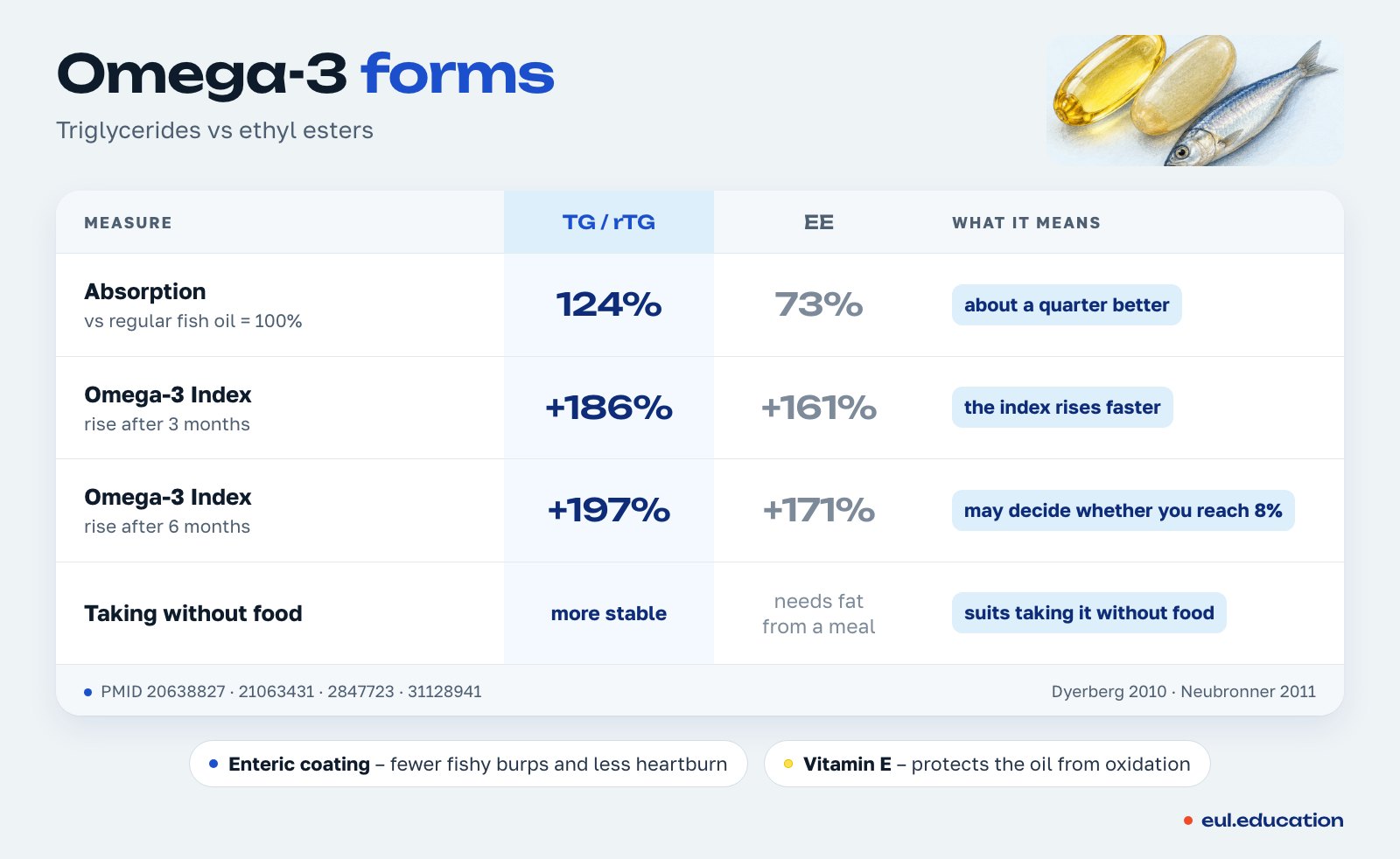
The triglyceride (TG) form of fish oil is absorbed at 124% of the level of regular fish oil, meaning about a quarter better, while ethyl esters (EE), which dominate budget supplements and pharmaceutical products, come in at 73%, meaning about a quarter worse.
Over six months of use, the TG form raised the Omega-3 Index by 197% versus 171% for ethyl esters – a difference that may decide whether you reach the cardioprotective threshold of 8% or stay in the high-risk zone below 4%.
What does the Omega-3 Index show?
The Omega-3 Index is a validated biomarker that measures EPA and DHA in red blood cell membranes as a percentage of total fatty acids. It directly reflects how much omega-3 actually reaches your tissues. And perhaps most important: many people who take standard fish oil report digestive complaints serious enough to make them stop long-term use.
Which form of omega-3 is absorbed better: triglycerides or ethyl esters?
A landmark pharmacokinetic study (PMID 20638827) compared the absorption of different omega-3 forms in healthy adults. For two weeks, 72 volunteers took about 3.3 g of EPA and DHA a day as the triglyceride form, ethyl esters, or free fatty acids, and the researchers then measured EPA and DHA in fasting blood.
The results were clear: bioavailability from the triglyceride form was 124% of regular fish oil, meaning about a quarter higher, and from ethyl esters it was 73%.
A follow-up six-month study (PMID 21063431, n=150) confirmed that these short-term differences carry over into clinically meaningful long-term effects.
Participants who took re-esterified triglycerides (rTG) raised their Omega-3 Index by 197%, compared with 171% in the ethyl ester groups.
Why are ethyl esters absorbed less well?
Ethyl esters need pancreatic lipase to cleave off the ethanol molecule before absorption can happen – a process that is inherently less efficient than digesting natural triglycerides (PMID 3358766). The TG form of omega-3, by contrast, mimics the molecular structure found in fish tissue, which lets it enter micelles directly and be absorbed through well-established lipid transport pathways.
Interestingly, this difference is most noticeable when supplements are taken without food. Absorption of the EE form drops sharply on an empty stomach, while the TG form keeps relatively stable bioavailability regardless of meal timing (PMID 2847723).
What happens to an omega-3 capsule after you swallow it?
Enteric coating: protection and delivery
Standard fish oil capsules dissolve in the stomach, where stomach acid and mechanical mixing can cause the familiar complaints: fishy burps, heartburn and nausea. These symptoms reflect oxidative breakdown of fragile omega-3 fatty acids and incomplete absorption.
Enteric coating changes this fundamentally. The protective layer stays intact in the acidic stomach (pH 1–3) and dissolves only when it reaches the alkaline environment of the small intestine (pH 6–7) – exactly where the lipid absorption machinery is concentrated.
An enteric coating was used in a one-year trial in Crohn’s disease: the authors chose it because regular fish oil is poorly tolerated due to its taste and digestive side effects. On this coated fish oil, 28% of patients had a relapse within the year, compared with 69% on placebo (PMID 8628335).
Vitamin E: an antioxidant shield
Omega-3 fatty acids are inherently vulnerable to oxidation because of the multiple double bonds in their structure. Oxidized fish oil loses effectiveness and can also cause harm by bringing lipid peroxides into cell membranes.
Adding vitamin E addresses this problem through two mechanisms:
First, vitamin E intercepts free radicals before they can start the chain reactions that destroy EPA and DHA. This keeps the product stable in storage and holds TOTOX (total oxidation) values below the quality threshold of 26, ideally below 10 for premium formulas.
Second, taking the two together produces antioxidant effects in the body. A meta-analysis of 9 randomized trials (PMID 31128941) found that, compared with placebo, the combination of omega-3 and vitamin E lowered malondialdehyde, a marker of lipid peroxidation, and raised total antioxidant capacity.
Why does a high Omega-3 Index matter?
Heart protection: the threshold matters
The Omega-3 Index system developed by Dr. William Harris divides cardiovascular risk into three zones (PMID 15208005):
| Omega-3 Index | Zone |
|---|---|
| <4% | High-risk zone (typical of Western populations not taking supplements) |
| 4–8% | Intermediate-risk zone |
| >8% | Cardioprotective zone. Men with the highest blood levels of omega-3 had about an 80% lower risk of sudden death than men with the lowest (PMID 11948270) |
Reaching the 8% threshold is more than a nice-to-have goal. It is the level at which large cardiovascular studies have shown meaningful prevention.
Critically, the form of omega-3 determined how fast the index rose. People taking the TG form raised it faster than the EE groups: at 3 months, the increase was 186% versus 161% (PMID 21063431) – a clinically relevant difference, given that cardiovascular events do not wait for slow bioavailability.
Brain, inflammation and cell membranes
Beyond cardiovascular outcomes, omega-3 fatty acids serve as structural components of nerve cell membranes and as precursors of specialized pro-resolving mediators (SPMs), which actively bring inflammatory responses to a close.
DHA makes up about 40% of the polyunsaturated fatty acids in the brain (PMID 32620164), where it affects membrane fluidity, neurotransmitter signaling and synaptic plasticity. EPA is the main substrate for anti-inflammatory eicosanoids and resolvins.
How efficiently supplemental omega-3 is built into these tissues depends directly on the absorbed dose. That makes the bioavailability advantage of the TG form, about a quarter, physiologically meaningful and more than a pharmacokinetic curiosity.
How to choose omega-3: what to look for on the label?
Criteria for a quality supplement
Form: Triglyceride (TG) or re-esterified triglyceride (rTG). Read the label carefully, since the words “fish oil” do not specify the molecular form. Ethyl esters are often listed as “EPA/DHA ethyl esters” or can be spotted by a lower price.
Coating: Enteric-coated capsules eliminate stomach complaints and make absorption more consistent. This matters especially for:
- People with sensitive digestion
- Those who prefer to take supplements without food
- Anyone who has stopped fish oil in the past because of side effects
Antioxidant protection: Added vitamin E prevents oxidation in storage and adds complementary benefits.
Quality check: Request or check TOTOX values – total oxidation should be <26 (the regulatory limit), ideally <10 for premium products. Fresh fish oil should have little or no fishy smell.
Omega-3 in triglyceride form with vitamin E is available in our store: Omega-3 in Triglyceride Form, Biogeek. Each capsule contains 529 mg EPA and 353 mg DHA, about 0.9 g combined. Discuss with your doctor how many capsules a day are right for you.
How much omega-3 should you take a day, and when should you check the index?
For most adults aiming for active longevity: 1–2 g of combined EPA/DHA daily. This usually takes 2–4 capsules of concentrated fish oil, depending on the product’s concentration.
For therapeutic uses (cardiovascular risk, inflammatory conditions): doses up to 4 g/day may be appropriate under medical supervision.
If you plan to start taking it on your own, discuss the dose and duration with your doctor.
Monitoring: Consider testing your Omega-3 Index at baseline and after 3–6 months of consistent use. Goal: >8% for optimal heart protection. Testing is available through several labs and gives objective feedback on whether your current protocol is working.
Final thoughts
Is the form of your omega-3 supplement the only factor that matters? No. Consistency of intake, overall dietary patterns and individual metabolic variability all play a role. Does choosing a premium TG form guarantee optimal health outcomes? Also no – omega-3 is only one component of a comprehensive approach.
Still, the evidence is clear: omega-3 supplements differ in the biological effects they deliver. The bioavailability advantage of the triglyceride form (about a quarter higher than regular fish oil), combined with the adherence benefits of enteric coating and the protective effects of added vitamin E, is a meaningful improvement over basic ethyl ester formulas.
My main takeaway from the pharmacokinetic literature: budget fish oil still has value, and the gap between taking a supplement and actually benefiting from it can be substantial. For something you will likely take daily for years, perhaps decades, the extra cost of a well-formulated product seems justified by the additional (and measurable) benefits.
Personally, I prioritize TG-form omega-3 with antioxidant protection whenever possible, while recognizing that any consistent omega-3 intake is better than none. For people with specific health goals – reaching cardiovascular Omega-3 Index thresholds, managing inflammatory conditions, or simply avoiding the digestive complaints that undermine adherence – formulation details matter more than marketing might suggest.
Comparison table of omega-3 forms
Questions I get asked
Which form of omega-3 is absorbed best?
The triglyceride (TG) or re-esterified triglyceride (rTG) form. In a study of 150 volunteers, six months of use raised the Omega-3 Index by 197% on the TG form and by 171% on ethyl esters. The words “fish oil” on the bottle do not name the form; ethyl esters are usually listed as “EPA/DHA ethyl esters.”
Can I take omega-3 on an empty stomach?
Ethyl esters are absorbed noticeably worse without food; they need fat from a meal. The TG form is more stable in this respect. If you prefer taking supplements without food, choose the TG form, and if your stomach is sensitive, choose enteric-coated capsules.
Why does fish oil cause burping and heartburn?
A regular capsule dissolves in the stomach, and acid plus mixing cause fishy burps, heartburn and nausea. An enteric coating withstands the acidic stomach and dissolves in the small intestine, where fat is absorbed. One more quality check: fresh fish oil barely smells of fish.
What Omega-3 Index is considered good?
An index above 8% is considered good. From 4 to 8% is intermediate risk, and below 4% is the high-risk zone, which is typical for people who do not take supplements. It is worth getting tested before you start and again after 3–6 months.
How much omega-3 should I take a day?
Most adults do well with 1–2 g of EPA and DHA combined a day, usually 2–4 capsules of a concentrate depending on the product. Doses up to 4 g a day are used for cardiovascular risk and inflammatory conditions under medical supervision. Discuss your dose with your doctor and check the result with an Omega-3 Index test.
Sources
- Bioavailability of forms: Dyerberg J et al. Bioavailability of marine n-3 fatty acid formulations. Prostaglandins Leukot Essent Fatty Acids, 2010. PMID 20638827
- Omega-3 Index (six-month comparison): Neubronner J et al. Enhanced increase of omega-3 index in response to long-term n-3 fatty acid supplementation from triacylglycerides versus ethyl esters. Eur J Clin Nutr, 2011. PMID 21063431
- Pharmacokinetics of MAG/TG: Chevalier L, Plourde M. Comparison of pharmacokinetics of omega-3 fatty acid supplements in monoacylglycerol or ethyl ester in humans. Eur J Clin Nutr, 2021. PMID 33011737
- Omega-3 with vitamin E and oxidative stress: Sepidarkish M et al. Effect of omega-3 fatty acid plus vitamin E co-supplementation on oxidative stress parameters. Clin Nutr, 2020. PMID 31128941
- Enteric-coated fish oil and Crohn’s disease relapses: Belluzzi A et al. Effect of an enteric-coated fish-oil preparation on relapses in Crohn’s disease. N Engl J Med, 1996. PMID 8628335
- Omega-3 and gastric secretion: Riber C et al. Fish oil reduces gastric acid secretion. Scand J Gastroenterol, 1999. PMID 10522600
- Ethyl ester absorption and the role of lipase: Lawson LD, Hughes BG. Human absorption of fish oil fatty acids as triacylglycerols, free acids, or ethyl esters. Biochem Biophys Res Commun, 1988. PMID 3358766
- Ethyl ester absorption with high-fat and low-fat meals: Lawson LD, Hughes BG. Absorption of eicosapentaenoic acid and docosahexaenoic acid from fish oil triacylglycerols or fish oil ethyl esters co-ingested with a high-fat meal. Biochem Biophys Res Commun, 1988. PMID 2847723
- Omega-3 Index zones: Harris WS, von Schacky C. The Omega-3 Index: a new risk factor for death from coronary heart disease? Prev Med, 2004. PMID 15208005
- Blood omega-3 and sudden death: Albert CM et al. Blood levels of long-chain n-3 fatty acids and the risk of sudden death. N Engl J Med, 2002. PMID 11948270
- DHA in brain phospholipids: Hsu MC et al. Beneficial effects of omega-3 fatty acid supplementation in schizophrenia: possible mechanisms. Lipids Health Dis, 2020. PMID 32620164
Disclosure: Nutrigeek is our store; we earn from purchases made there. These statements have not been evaluated by the Food and Drug Administration. This product is not intended to diagnose, treat, cure, or prevent any disease. This article is for education and does not replace a consultation with your doctor.

Yulia Yusipova, MD
Physician (MD), Rector of European University of Longevity and American Academy of Longevity.