Creatine beyond the gym: what this molecule is, why the brain needs it, and why it works especially well for women over 40

In short. Creatine works for muscle, bone and the brain, so calling it a “gym supplement” leaves out most of the story.
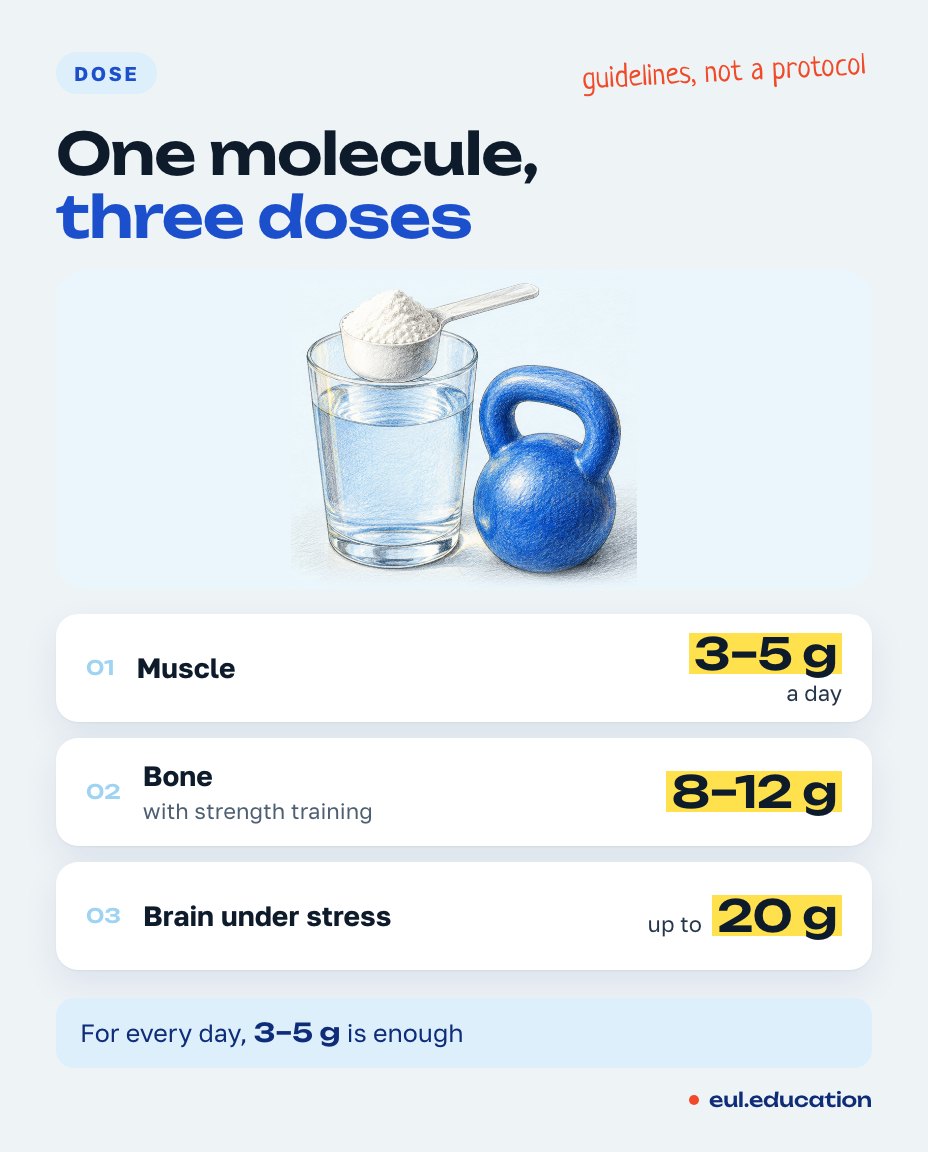
- The dose depends on the goal: muscle 3–5 g a day, bone 8–12 g (only together with strength training), a brain under stress up to 20 g as a single dose.
- With poor sleep, long flights and perimenopause, the brain runs short of its own creatine. This is where a supplement helps.
- In depression, creatine is only an add-on to treatment, never a replacement for it.
- It matters most for women after 40: estrogen becomes unstable and creatine stores go down.
Why “a gym supplement” is the wrong way to describe it
The brain makes up about 2% of body weight, yet at rest it uses about 20% of all the body’s energy. Still, most of us think of creatine only in terms of bench presses, powder in a shaker and muscle gain. Dr. Darren Candow sees it differently. He is a professor at the University of Regina, director of the Aging Muscle and Bone Health Laboratory, and the author of more than 120 peer-reviewed papers on creatine alone.
In a recent interview he put it this way: in 120-plus papers on creatine alone, he has not come across a person for whom this supplement would be contraindicated. There are caveats, and we will come back to them. But the starting point matters. This is a molecule of cellular energy. “Sports nutrition” is the wrong shelf for it.
These days Candow is most interested in women in perimenopause and postmenopause. The reason is that estrogen takes a direct part in creatine metabolism. When estrogen falls, cellular energy changes in three places at once: in muscle, in bone and in the brain.
What creatine is at the level of biochemistry, and why the body can’t always keep up on its own
Production, storage, use
The body makes 1-3 g of creatine a day. It happens in two steps: in the kidneys, an intermediate product is formed from glycine and arginine (the AGAT enzyme), and then in the liver, with the help of SAMe, it is turned into creatine itself (the GAMT enzyme). This production is expensive: it uses about 50% of all the methyl groups SAMe supplies in a day. When you take ready-made creatine, the need to make your own drops, and the body “saves” methyl groups for other processes; homocysteine goes down slightly as a result. By the way, this is the exact opposite of what you sometimes hear: the supplement protects methylation instead of “eating it up.”
95% of the body’s creatine is stored in skeletal muscle. The brain makes its own share, but creatine crosses the blood-brain barrier poorly.
Now about women. Smith-Ryan and colleagues (2021, PMID 33800439) showed that women’s muscle creatine stores are 70–80% lower than men’s. Estrogen regulates AGAT, that same rate-limiting enzyme of creatine production. Unstable estrogen in perimenopause means less production. By the same logic, the brain’s energy suffers too: the shortfall grows right at the time when many women start to complain of brain fog.
Vegans and vegetarians look similar: they get no creatine from meat, so their baseline stores are low from the start. This is how Candow explains what he has observed: women and vegans respond to the supplement best of all. The logic is simple. The lower the stores, the more noticeable the effect.
Muscle
Mass and strength: what actually grows
No embellishment here. According to Candow, the gain in lean mass on creatine is about 0.86 kg over 6 weeks and 1.2–2 kg in longer protocols. About half of that gain is water held inside the muscle fibers, and only the rest is muscle. “The gain is small,” he admits himself.
The data on performance look more convincing: strength, explosive power, training volume, how fast you recover between sets. A meta-analysis in postmenopausal women (PMID 42141930) found gains in both lean mass and strength. The mechanism: water fills the cell, and this acts as a signal to build protein while also slowing its breakdown.
What about fat loss? If fat mass does go down, it is most likely an indirect effect of gaining active tissue and better metabolism.
Bone: only together with exercise, and an honest look at the data
What the evidence shows
Here you can’t oversimplify in either direction. A two-year randomized trial of 3 g a day in postmenopausal women (Sales 2020, PMID 31257405) showed clearly that creatine on its own, without strength training, does not raise bone density. The authors state plainly that this refutes the idea that the supplement builds bone in isolation.
The picture changes when strength training is added. Chilibeck and colleagues (2015, PMID 25386713) saw a slower loss of density at the femoral neck in postmenopausal women when creatine was combined with strength training. Candow himself describes it carefully: creatine did not raise bone density, but it did slow its loss. The mechanism is a shift in the balance between osteoblasts and osteoclasts toward building. He compares this to how bisphosphonates work, adding that they are not perfect either.
A 2018 meta-analysis (PMID 29740583) found no significant gain in BMD across the population as a whole. The data are mixed. The honest frame: without strength training there is no bone effect; with strength training there is probably a slower loss, without a return of lost density. The dose for this protocol is 8-12 g a day, higher than the standard muscle dose.
The dose dilemma: why one number doesn’t work for everything
Different organs need different doses
Each target organ has its own working dose, and they don’t match.
- Muscle: 3-5 g a day. Three grams is the minimum effective dose, and filling up the muscle takes about 30 days (without a loading phase). After 50, Candow recommends a little more.
- Bone: 8-12 g a day, and only if you do strength training.
- The brain under metabolic stress: studies point to 15-20 g as an acute dose. In a study with 21 hours of sleep deprivation, researchers in Germany gave a single bolus of about 30 g. They recorded higher brain creatine levels and a partial recovery of cognitive function the next day. A lower dose (about 14 g) had no effect.
A loading phase (20 g a day for 5-7 days) fills the stores faster, but it causes acute water retention and gut discomfort. You don’t need it.
Candow himself takes 10 g a day as “insurance,” and 20–25 g as a single dose when he flies across time zones. Judging by recent data, timing plays no role: morning, evening, before or during a workout make no difference.
The brain under stress: a healthy brain and a stressed brain have different needs
This is a new line in Candow’s work and, in my view, the most interesting one for anyone who works night shifts, flies often or is going through perimenopause with the poor sleep that so often comes with it.
A healthy brain hardly needs creatine: it makes enough on its own. Under metabolic stress, though – poor sleep, time zone changes, mental work on top of fatigue – phosphocreatine stores in neurons run down faster than they are refilled. Candow puts it like this: a healthy brain probably doesn’t need the supplement, a brain under stress does, and the stronger the stress, the higher the dose it needs.
In one study (I describe it in general terms, without a reference number: I did not verify this data for this post), participants took the Stroop test after taking 20 g of creatine and showed a significant improvement in speed and accuracy. And right away, an honest caveat from Candow himself: you will most likely not feel anything subjectively. We are talking about objective measures the next day. A sense of alertness is a different thing. The brain science here is early, and there is little data so far.
One more caveat: Alzheimer’s disease, neuroprotection after traumatic brain injury and cancer hypotheses are so far supported only by pilot studies in small groups or by data from cell cultures and rodents.
Mood and depression: only as an add-on
One well-designed result deserves a separate mention. Lyoo and colleagues (2012, PMID 22864465, Am J Psychiatry) studied 52 women with major depression. The participants took escitalopram plus either 5 g of creatine or a placebo for 8 weeks. The creatine group improved faster and more strongly, and the difference was statistically significant. The effect showed up as early as week 2.
The mechanism fits the logic: in depression, phosphocreatine levels in the brain go down and neuron energy is disrupted. The supplement brings the system back to normal. It fills a deficit. Calling it a “boost” misses the point.
A firm caveat: only as an add-on to prescribed treatment, under a doctor’s supervision. Never on its own. Never as self-treatment for anxiety.
Myths, taken apart by mechanism
Kidneys. Serum creatinine really does go up when you take the supplement, and this creates a false drop in eGFR. This is a measurement artifact with no kidney harm behind it: the eGFR formula “assumes” that high creatinine means lower filtration, while the creatinine actually comes from the supplement. The right marker of kidney function in this situation is cystatin C. Randomized trials with long follow-up have shown no kidney toxicity. A practical tip: tell your doctor you take creatine before you have a metabolic panel drawn.
Water retention. Acute retention is possible during a loading phase: creatine molecules pull water in. On a maintenance dose it goes away. Over the long term, water is held inside the muscle cells. That is useful hydration, and it has nothing to do with swelling.
Hair loss. One old protocol in rugby players recorded a small rise in DHT (within the normal range), and that is all. Hair loss was not measured at all. Later studies with 5 g for 6-8 weeks showed no effect on DHT.
“Only for men.” As we have already seen, women respond to the supplement more strongly at the physiological level. This is a false belief that comes from the history of marketing. The data say otherwise.
Gut discomfort. This is real with large single doses (10 g and up): osmosis pulls water into the gut. The fix is to split the dose. A microdosing protocol (for example, 1 g every 30 minutes up to a total of 20 g) makes it much easier to tolerate.
A note on kidney disease: with chronic kidney disease, only together with a nephrologist. Pregnancy and breastfeeding: there is little data so far, and the decision is made with your own doctor.
In practice: what this looks like for a woman over 40
Level 1 – the basic protocol
Monohydrate, 3-5 g a day, at any time of day, in anything you like: water, kefir, coffee, a protein shake. According to current data, timing doesn’t matter. The form should be monohydrate only: the evidence for ethyl ester, hydrochloride and other versions is weaker, and they cost more.
Product quality matters here. Market audits show that a large share of products on store shelves contain noticeably less creatine than the label says. Look for supplements with independent third-party certification. In the US market, that means products made with Creapure (a certified raw material from Germany) or labeled NSF Certified for Sport / Informed Sport.
If you and your doctor decide on creatine, this is the monohydrate we stock: Creatine Monohydrate powder, Biogeek.
Level 2 – if you do strength training
Increase to 8-10 g a day if your goal includes supporting bone. Remember: without exercise there is no bone effect. Strength training is a required part of this protocol, with no way around it.
Level 3 – the acute stress protocol
Before a night shift, a long flight, exam week or a stretch of acute sleep loss, Candow’s data suggest an occasional 20 g (split into several portions over the day). This is a situational dose, for specific days only. Chronic megadoses of 20-30 g are not recommended.
The bottom line
So where does that leave us? Creatine is one of the most thoroughly studied supplements in terms of safety. It has a proven effect on strength and recovery, a likely effect on slowing bone loss when combined with strength training, and a promising line of data on metabolic stress: poor sleep, brain fog in perimenopause, mental workload. That last point hits hardest, because women over 40 live with exactly this kind of stress more often than people tend to discuss.
I take this molecule myself for exactly this reason: 5 g of monohydrate a day and 15–20 g on long flights. I’m not after a “boost.” With the current level of evidence, it is a cheap and safe tool that hits several targets at once. There is no perfect dose for each goal yet, and Candow says so directly. But the lack of a perfect protocol is no reason to put it off.
Sources and resources
- The Diary Of A CEO, interview with Dr. Darren Candow: https://www.youtube.com/watch?v=Jk7RAkFN4vk
- Smith-Ryan AE et al. (2021). Creatine Supplementation in Women’s Health: A Lifespan Perspective. *Nutrients.* PMID 33800439
- Lyoo IK et al. (2012). A Randomized, Double-Blind Placebo-Controlled Trial of Oral Creatine Monohydrate Augmentation for Enhanced Response to a Selective Serotonin Reuptake Inhibitor in Women with Major Depressive Disorder. *Am J Psychiatry.* PMID 22864465
- Chilibeck PD et al. (2015). Effect of creatine supplementation during resistance training on lean tissue mass and muscular strength in older adults: a meta-analysis. *Open Access J Sports Med.* PMID 25386713
- Sales LP et al. (2020). Creatine Supplementation (3 g/d) and Bone Health in Older Women: A 2-Year, Randomized, Placebo-Controlled Trial. *J Gerontol A Biol Sci Med Sci.* PMID 31257405
- BMD meta-analysis (2018). PMID 29740583
- Postmenopause meta-analysis: lean mass/strength/BMD. PMID 42141930
Warmly, Yulia and the EUL Education team
FAQ
Do I need a loading phase? No. Loading (20 g a day for 5-7 days) fills the stores about 30 days sooner, but it isn’t necessary. 3-5 g a day gets you to the same result, just more slowly.
When should I take it, morning or evening? According to current data, timing doesn’t matter. Take it whenever it’s easiest to remember.
Can I take it with caffeine? According to Candow, caffeine doses up to 350 mg are compatible with creatine, and the effects don’t clash.
How can I tell if a product is good quality? Look for an NSF Certified for Sport or Informed Sport label, or Creapure as the raw material. Without certification, there is a risk that the contents won’t match the label.
Is it safe with kidney disease? With chronic kidney disease, only together with a nephrologist. For healthy people, data on more than 25,000 cases show no kidney toxicity.
About the author
Yulia Yusipova, MD, Rector of European University of Longevity and American Academy of Longevity. A physician specializing in functional and longevity medicine, she works in Miami (USA). She has worn a continuous glucose monitor (CGM) since 2018 and builds her work on an evidence-based approach to nutrition, lab testing and longevity.
More from me on Instagram: @dr.yusipova_official.
Disclosure: Nutrigeek is our store; we earn from purchases made there. These statements have not been evaluated by the Food and Drug Administration. This product is not intended to diagnose, treat, cure, or prevent any disease. This article is for education and does not replace a consultation with your doctor.

Yulia Yusipova, MD
Physician (MD), Rector of European University of Longevity and American Academy of Longevity.