
In short. Take vitamin D every day, once, with your main meal, as D3 (cholecalciferol). The guide for a healthy woman under 70 is the daily amount of 600 IU; after 70 it is 800 IU. In large trials on tens of thousands of people, doses above that “for prevention” brought no benefit. Infrequent bolus doses, once a month or once a year, even added falls. If there is a reason to suspect a deficiency, first get a 25(OH)D test together with C-reactive protein and choose the dose with your doctor.
Yulia Yusipova, MD, Rector of European University of Longevity and American Academy of Longevity. October 2026.
“I take vitamin D every day, and my test still shows 20. Should I go up to 10,000 IU?” a patient asks.
I wouldn’t rush to raise the dose. Since 2019, trials have come out on 25,871 Americans, 21,315 Australians and 2,423 people with prediabetes, and in people without a deficiency, vitamin D above the daily amount did not prevent disease.
This article is about practice only. The debates around vitamin D and my breakdown of two well-known podcasts are a topic for a separate article.
How should you take vitamin D?
Once a day with your most substantial meal, preferably as D3. If there is no reason for a test, aim for the daily amount. If there is a reason, the dose is chosen with your doctor based on your test result and weight.
The rules that have data behind them:
- Every day. The Endocrine Society, the US professional society of endocrinologists, advises daily use for people over 50 in its 2024 guideline. It does not recommend infrequent large doses (PMID 38828931).
- With food. Vitamin D dissolves in fat. Taken with a breakfast that contained fat, its peak in the blood came out a third higher than with a fat-free breakfast (PMID 25441954).
- D3. Cholecalciferol raises the blood level more than D2.
- Dose by the daily amount or by your test. 600 IU a day up to age 70, 800 IU after 70. More than that only after a test and a talk with your doctor.
- Follow-up. If your doctor prescribed a dose above the daily amount, a repeat test will show whether it worked. Your doctor will tell you when to retest.
IU stands for international units. Labels list either IU or micrograms: 1 mcg equals 40 IU, so 25 mcg equals 1,000 IU.
Do you need a vitamin D test?
Yes, if there is a reason to suspect a deficiency or you plan to take more than the daily amount. In 2024 the Endocrine Society advised against testing all healthy people across the board: there are no trials where such testing improved health, and experts have not agreed on a target level either.
The test is called 25(OH)D, or 25-hydroxyvitamin D. This is the form in which vitamin D circulates in the blood.
Reasons for a test worth mentioning to your doctor:
- bowel disease or stomach or intestinal surgery, after which fats are absorbed less well;
- osteoporosis or low bone density;
- medications that change how your body handles vitamin D (your doctor will check the list);
- you already take a dose above the daily amount or plan to;
- your doctor suspects a deficiency based on symptoms or other tests.
It is better to look at 25(OH)D together with C-reactive protein (CRP), a marker of inflammation. The reason is that during inflammation the blood level of vitamin D drops on its own. In 30 people after knee or hip replacement, CRP rose from 5 to 116 mg/L within two days, and 25(OH)D fell from about 22 to 18 ng/mL (PMID 23454726). The vitamin dose did not change over those two days.
So a low vitamin D with a high CRP is first a reason to look into the inflammation. Doubling the drops at that point is premature.
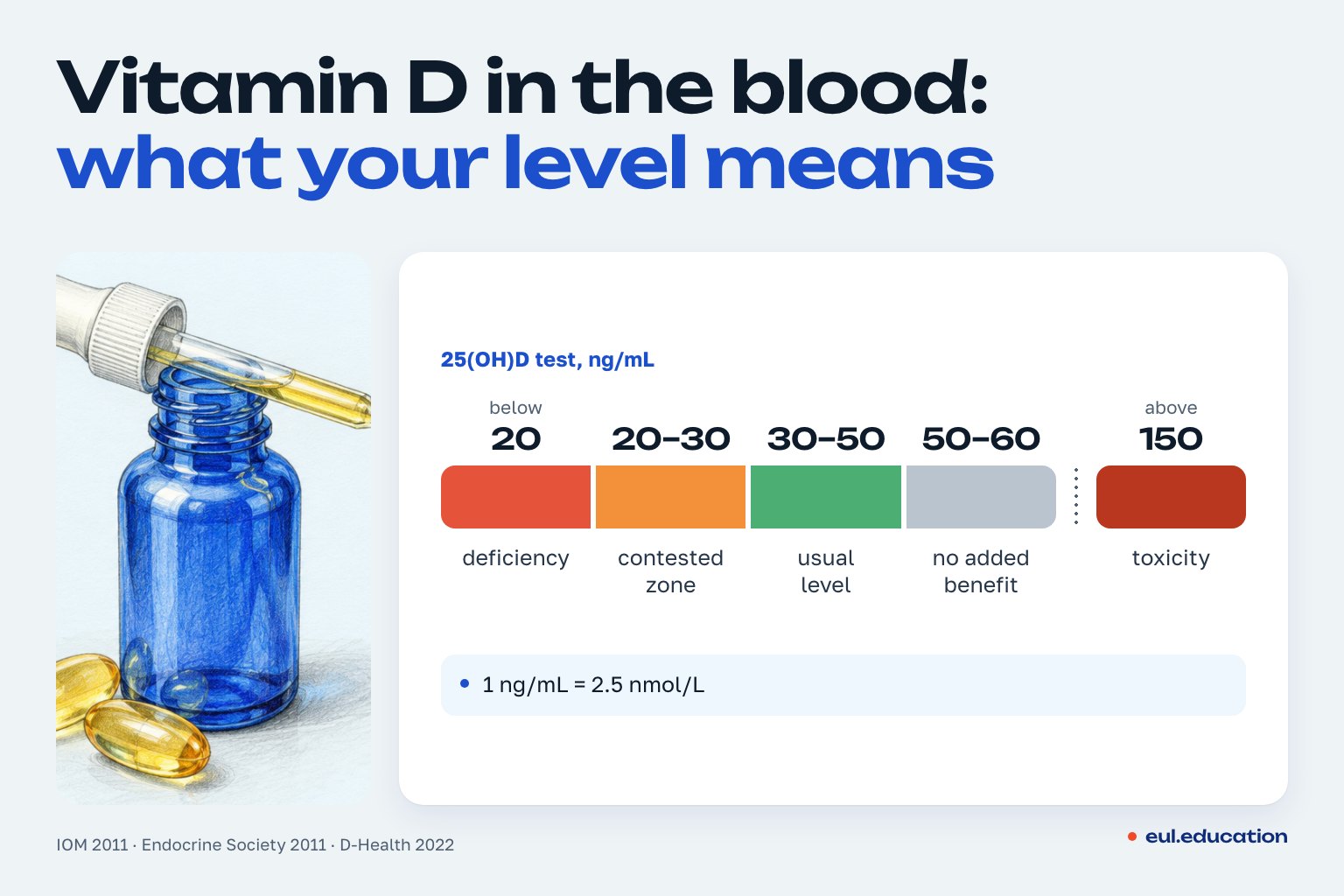
Why do lab reports show different reference ranges? In 2011 the US Institute of Medicine decided that a level of 20 ng/mL is enough for 97.5% of people and noted that deficiency in North America is overestimated (PMID 21118827). The Endocrine Society guideline from the same year called 21–29 ng/mL insufficiency and set a treatment target above 30 ng/mL (PMID 21646368). The 2024 guideline names no target level at all.
Your 25(OH)D result: what it means
| 25(OH)D level | What it means | Source |
|---|---|---|
| about 10 ng/mL (25 nmol/L) | Severe deficiency. In genetic data, the chance of dying within 14 years is a quarter higher than at 20 ng/mL | Sutherland 2022 |
| below 20 ng/mL (50 nmol/L) | Deficiency according to the Institute of Medicine and the Endocrine Society 2011. Below this line, risk climbs steeply | IOM 2011, Holick 2011, Sutherland 2022 |
| 20–30 ng/mL (50–75 nmol/L) | Enough for 97.5% of people according to the Institute of Medicine. The Endocrine Society 2011 calls it “insufficiency,” with a target above 30 | IOM 2011, Holick 2011 |
| 30–50 ng/mL (75–125 nmol/L) | The usual level on moderate doses. In D-Health the placebo group was at about 31 ng/mL, and a supplement on top did not lower mortality | D-Health 2022 |
| 50–60 ng/mL (125–150 nmol/L) | No added benefit. In D2d at 54 ng/mL the difference in diabetes stayed within chance; in Burt’s trial, at 53–58 ng/mL bone lost density faster than at 31. The Institute of Medicine raised concerns about levels above 50 ng/mL back in 2011 | D2d 2019, Burt 2019, IOM 2011 |
| above 150 ng/mL (375 nmol/L) | A sign of vitamin D toxicity, usually together with high blood calcium | Marcinowska-Suchowierska 2018 |
1 ng/mL equals 2.5 nmol/L. Trials have not yet shown which level is best for prevention.
How much vitamin D should you take a day?
The daily amount for adults up to age 70 is 600 IU (15 mcg); after 70 it is 800 IU (20 mcg). The upper limit for adults is 4,000 IU a day, so don’t go above it without a doctor (PMID 21118827). With a confirmed deficiency, your doctor chooses the dose based on your test and weight.
The Institute of Medicine set these amounts for conditions with almost no sun: how much vitamin D the skin makes varies a lot from person to person, and tanning raises the risk of skin cancer. The daily amount covers everything together: food, fortified foods and supplements.
How much a dose adds depends on your starting level and weight. In the British BEST-D trial, 305 people over 65 started at about 20 ng/mL. After a year, 2,000 IU a day raised the level to about 41 ng/mL and 4,000 IU to 55 ng/mL, and in people with excess weight, doubling the dose added less (PMID 27986983). The same dose will give a different result in a slim woman and in a heavier one.
Based on these data, taking 4,000 IU or more for years “just in case” is not worth it. In a Canadian trial, 311 healthy people aged 55–70 took 400, 4,000 or 10,000 IU a day for three years. Forearm bone density dropped by 1.2%, 2.4% and 3.5%, respectively (PMID 31454046). To be fair, estimated bone strength barely differed, and the high doses brought no benefit either.
What about the safety of such doses? In a review of trials where people got 2,800 IU a day or more for a year or longer, side effects overall and kidney stones did not increase. High blood calcium showed up almost twice as often, though that difference sits right at the edge of chance (PMID 30529281).
If your doctor has already prescribed you a treatment dose, don’t change it on your own because of this article. Discuss with your doctor what level you need and when to retest.
Does vitamin D help “for prevention” if you are not deficient?
In people without a deficiency, large trials found no benefit. Cancer, heart attacks and strokes, fractures, diabetes and deaths came out almost the same in the vitamin D and placebo (dummy pill) groups.
VITAL, USA. 25,871 people: men from age 50 and women from 55, 2,000 IU a day, 5.3 years on average. Cancer was found in 793 people on vitamin D and 824 on placebo; heart attack, stroke or death from heart disease in 396 and 409 (PMID 30415629). Fractures occurred in 769 and 782 people, and the result did not depend on the starting vitamin D level (PMID 35939577).
D-Health, Australia. 21,315 people aged 60–84, 60,000 IU once a month, for up to five years. 562 people died in the vitamin D group and 538 on placebo (PMID 35026158).
D2d, USA. 2,423 people with prediabetes, 4,000 IU a day, 2.5 years. The blood level rose from 27.7 to 54.3 ng/mL. Diabetes developed in 293 people on vitamin D and 323 on placebo, and a difference like that cannot be told apart from chance (PMID 31173679).
A review of 81 trials in 53,537 people reached the same conclusion for bones: vitamin D did not change fractures, falls or bone density, and high doses worked no better than low ones (PMID 30293909).
The same VITAL trial noticed a possible benefit. Autoimmune diseases (rheumatoid arthritis, autoimmune thyroiditis, psoriasis and others) appeared over five years in 123 people on vitamin D and 155 on placebo (PMID 35082139). That was a secondary question of the trial, though, with a result right at the edge of chance, so it is too early to take vitamin D to protect against autoimmune disease based on this one study.
Who the Endocrine Society does advise, in 2024, to take vitamin D above the daily amount without a test: children and teens, people 75 and older, pregnant women and people with high-risk prediabetes. If you are in one of these groups, discuss the dose with your doctor.
A separate word about women aged 40–54. There are almost no data on you specifically: VITAL enrolled women from age 55, and D-Health enrolled everyone from 60. No large vitamin D trial has studied perimenopause on its own, so the conclusions have to be carried over from women 10–20 years older.
If vitamin D was prescribed to you for a specific reason (osteoporosis, bowel or kidney disease, a confirmed deficiency), these trials don’t apply to you. Don’t stop prescribed vitamin D without your doctor.
Why are large doses of vitamin D risky?
The biggest questions are about infrequent bolus doses: 500,000 IU once a year and 60,000 IU once a month added falls or fractures in trials. True toxicity is rare and usually comes from a dosing error.
In an Australian trial, 2,256 women aged 70 and older received 500,000 IU once a year. The vitamin D group had 15% more falls and a quarter more fractures than the placebo group (PMID 20460620).
In Switzerland, 200 people aged 70 and older who had already had a fall received 24,000 or 60,000 IU once a month. Over a year, 67 of every 100 people on the higher dose fell, compared with 48 of 100 on the lower dose (PMID 26747333).
In D-Health, 60,000 IU once a month did not add falls overall. In people with normal weight, though, the chance of falling was a quarter higher (PMID 34337905).
Vitamin D toxicity is recognized by a blood level above 150 ng/mL plus high calcium. The signs: nausea and vomiting, thirst, frequent urination, belly pain, confusion (PMID 30294301). Most often it is caused by a wrong dose. Seven children were given fish oil that, because of a manufacturing error, contained about 4,000 times more vitamin D than the label said (PMID 24298009). So choose a supplement whose contents are independently tested.
Kidney stones are linked to calcium and vitamin D taken together. In the US WHI trial, 36,282 postmenopausal women took 1,000 mg of calcium and 400 IU of vitamin D for seven years. Hip bone density rose by about 1%, hip fractures did not drop noticeably, and kidney stones went up by 17% (PMID 16481635). If you are offered calcium together with vitamin D, ask your doctor whether you need it with your diet.
Which vitamin D is best?
D3 (cholecalciferol): in a review of head-to-head trials it raised the blood level more than D2 (ergocalciferol). Drops, capsules and tablets have hardly been compared directly, so pick an oil-based form that is easy for you to take every day.
The gap between D3 and D2 is larger with infrequent large doses; with daily use it narrowed (PMID 22552031).
For liposomal vitamin D (the molecules are packed into tiny fat bubbles), there is one 2026 trial in 612 postmenopausal women. Over two years, the blood level reached 38 ng/mL on 800 IU of the liposomal form and 28 ng/mL on 1,200 IU of regular cholecalciferol, and the difference in fractures could not be told apart from chance (PMID 42567908). I wouldn’t pay extra for the liposomal form based on one study.
When to take vitamin D: morning or evening?
No trials have compared taking it in the morning versus the evening, so pick the time of day that suits you. Tie vitamin D to your largest meal: that makes it easier to remember, and small studies suggest it is absorbed better with food.
In 17 patients whose vitamin D level would not rise, doctors switched them to taking it with their largest meal. Over 2–3 months the level rose on average from 30 to 47 ng/mL (PMID 20200983). There was no comparison group.
In another trial, 62 older adults took a large dose of D3 on an empty stomach, with a high-fat breakfast or with a fat-free one. Absorption differed slightly, while the test level at 30 and 90 days rose equally in all three groups (PMID 23427007). Taking it with food is convenient and costs nothing, though the data don’t support the rule “only with fatty food, or it won’t be absorbed.”
The fear that “vitamin D in the evening will ruin your sleep” rests on a 2012 hypothesis that was never tested in a trial (PMID 22583560). In a review of 19 studies, vitamin D tended to improve sleep quality (PMID 35268051). If you sleep worse after an evening dose, move it to the morning.
How to take vitamin D drops
Check the label for how many IU are in one drop, and count the drops one at a time. Put them on a spoonful of food during your main meal, once a day.
Different bottles hold different amounts per drop, sometimes several times more. When you switch bottles, recalculate the dose. If the label lists micrograms, multiply by 40: 25 mcg is 1,000 IU.
I haven’t found studies comparing drops with capsules, so choose what you will actually take every day. If drops suit you better and you and your doctor decide on vitamin D3, this is the one we stock: Micellized Vitamin D3 drops (Biogeek).
Should you take vitamin D with K2 and magnesium?
There is no required pairing. K2 is worth discussing with a cardiologist when a heart CT scan has already found calcium in the arteries. Magnesium makes sense if both vitamin D and magnesium are low.
For bones, the data on K2 are thin. A review of 36 vitamin K trials in postmenopausal women and people with osteoporosis did not find enough evidence to say whether it lowers fractures (PMID 31076817).
For arteries there are data, though in a narrow group. In the Dutch VitaK-CAC trial, 180 people with calcium already found in their coronary arteries took 360 mcg of vitamin K2 (MK-7) or placebo for two years, and the calcium in their arteries grew more slowly (PMID 42268593). In the Danish DANCODE trial, 398 people with marked calcification (a calcium score of 400 or higher) took 720 mcg of K2 together with 1,000 IU of D3 for two years, and calcium built up 21% more slowly than on placebo (PMID 42661461).
Both studies were done in people who already had calcium in their arteries, and DANCODE did not test the contribution of vitamin D separately. If your calcium score (a heart CT scan) is high, discuss K2 with a cardiologist. If you take warfarin, don’t take vitamin K without your doctor: it weakens the drug’s effect. If you and your doctor decide on K2 together with D3, this is the one we stock: Vitamin D3+K2 (Premier Research Labs).
Magnesium is needed by the enzymes that convert vitamin D into its working forms (PMID 29480918). In a trial of 180 people, it raised vitamin D in those whose level was around 30 ng/mL or lower and lowered it in those at 30–50 ng/mL (PMID 30541089). If you have kidney disease, don’t start magnesium without your doctor.
Which foods contain vitamin D?
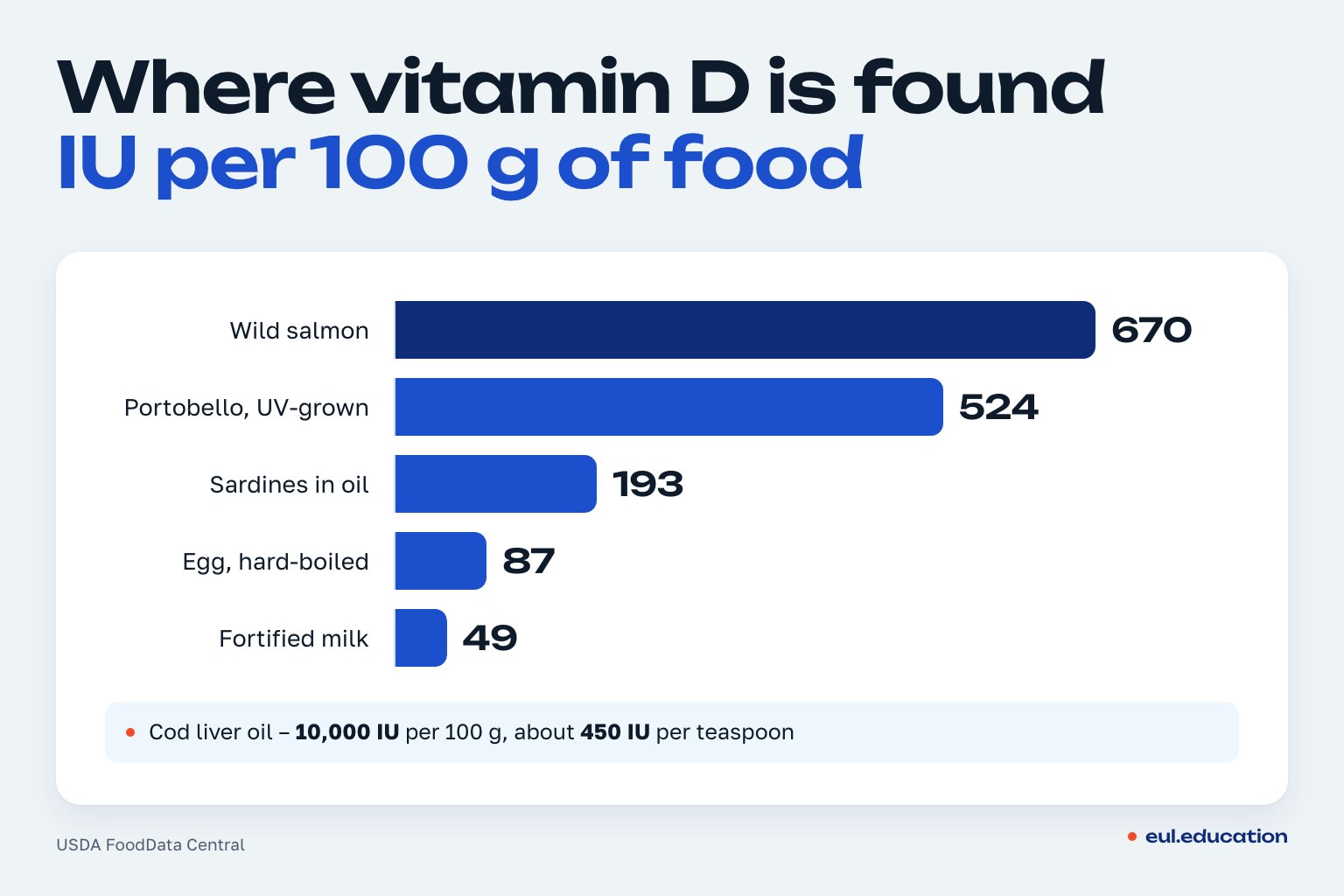
Fatty fish, such as wild salmon and sardines, and cod liver oil have the most vitamin D. Eggs, beef liver and fortified milk have less. Mushrooms grown under ultraviolet light give a sizable amount, but in the D2 form.
Getting 600–800 IU a day from food alone is hard. The Endocrine Society says plainly in its 2024 guideline that natural sources are few and suggests combining fortified foods and supplements (PMID 38828931).
| Food (per 100 g) | Vitamin D, IU | What it means in practice |
|---|---|---|
| Cod liver oil | 10,000 | a teaspoon (4.5 g) has about 450 IU |
| Wild salmon (sockeye), cooked | 670 | a 100 g serving covers more than the daily amount |
| Portobello mushrooms grown under UV light, grilled | 524 | all of the vitamin D here is D2 |
| Sardines canned in oil, with bones | 193 | a 92 g can has about 180 IU |
| Egg, hard-boiled | 87 | one egg (50 g) has about 45 IU |
| Milk 2%, fortified with vitamin D | 49 | a cup (244 g) has about 120 IU |
| Beef liver, braised | 49 |
Figures are from the US Department of Agriculture database USDA FoodData Central (SR Legacy). The content depends on the type of fish, how it is cooked and whether the milk is fortified.
My take
Vitamin D is needed when there is a true deficiency. A genetic analysis of 307,601 people from the UK Biobank compared people whose genes set a lower or higher level from birth. The risk of death rose steeply when the level fell below 20 ng/mL, and at 10 ng/mL the chance of dying within 14 years was a quarter higher than at 20 (PMID 36279545). The study was done in white Europeans, true. For me it is still a reason to look for a deficiency.
For vitamin D, “more is better” did not hold up in trials. If your result is low, here is the order I suggest discussing with your doctor: check CRP, then how you take the vitamin (every day or not, with food or not, in what form), look at magnesium and weight. Change the dose only after that.
I take 2,000 IU of vitamin D myself, and even that under the control of a test I check regularly. Along with it I take magnesium and K2 as MK-7. That is my decision based on my own labs; don’t copy it without your own labs and your doctor.
Vitamin D questions I hear most often
Can I take vitamin D every day without a test?
Within the daily amount (600 IU up to age 70, 800 IU after), yes: that is far below the upper safe limit of 4,000 IU. For healthy people under 75, the Endocrine Society does not advise more than the daily amount without a test: in large trials it brought no benefit. If you want to take more, get tested first and discuss the dose with your doctor.
Does a woman of 45–50 in perimenopause need vitamin D?
There is little direct data: large trials enrolled women from age 55–60 and did not study perimenopause separately. So the decision is the same: the daily amount if there is no particular reason, and a test if there is a reason to suspect deficiency, such as osteoporosis or a bowel condition.
Why isn’t my vitamin D level going up even though I take it?
Common reasons: inflammation (CRP is high, and blood vitamin D falls on its own), excess weight, irregular use, taking it without food, low magnesium, bowel disease. Before raising the dose, talk with your doctor about CRP, magnesium and how you take the supplement.
What vitamin D level counts as good?
There is no single number. The US Institute of Medicine considers 20 ng/mL sufficient, the 2011 Endocrine Society guideline aimed for above 30 ng/mL, and the new 2024 guideline names no target. Levels above 50 ng/mL added no benefit in trials.
Can you overdose on vitamin D?
Yes, but at usual doses it is rare. Toxicity is recognized by a level above 150 ng/mL plus high calcium; the signs are nausea, thirst, frequent urination and confusion. Most often it comes from dosing errors and supplements whose contents were never tested.
Can I take vitamin D with calcium?
Yes, if you need the calcium. In a trial of 36,282 postmenopausal women, calcium with vitamin D raised kidney stones by 17%, and hip fractures did not drop noticeably. Whether you need calcium with your diet is a question for your doctor.
Should I take vitamin D in summer?
It depends on your level and lifestyle: how much vitamin D the skin makes varies from person to person. The daily amounts were set for conditions with almost no sun, so taking the daily amount in summer is safe. A test will show whether you need a higher dose.
Sources
- Demay MB et al. Vitamin D for the Prevention of Disease: An Endocrine Society Clinical Practice Guideline. J Clin Endocrinol Metab, 2024. PMID 38828931
- Ross AC et al. The 2011 report on dietary reference intakes for calcium and vitamin D from the Institute of Medicine: what clinicians need to know. J Clin Endocrinol Metab, 2011. PMID 21118827
- Holick MF et al. Evaluation, treatment, and prevention of vitamin D deficiency: an Endocrine Society clinical practice guideline. J Clin Endocrinol Metab, 2011. PMID 21646368
- Manson JE et al. Vitamin D Supplements and Prevention of Cancer and Cardiovascular Disease (VITAL). N Engl J Med, 2019. PMID 30415629
- LeBoff MS et al. Supplemental Vitamin D and Incident Fractures in Midlife and Older Adults. N Engl J Med, 2022. PMID 35939577
- Hahn J et al. Vitamin D and marine omega 3 fatty acid supplementation and incident autoimmune disease: VITAL randomized controlled trial. BMJ, 2022. PMID 35082139
- Neale RE et al. The D-Health Trial: a randomised controlled trial of the effect of vitamin D on mortality. Lancet Diabetes Endocrinol, 2022. PMID 35026158
- Waterhouse M et al. Vitamin D supplementation and risk of falling: outcomes from the randomized, placebo-controlled D-Health Trial. J Cachexia Sarcopenia Muscle, 2021. PMID 34337905
- Pittas AG et al. Vitamin D Supplementation and Prevention of Type 2 Diabetes (D2d). N Engl J Med, 2019. PMID 31173679
- Bolland MJ et al. Effects of vitamin D supplementation on musculoskeletal health: a systematic review, meta-analysis, and trial sequential analysis. Lancet Diabetes Endocrinol, 2018. PMID 30293909
- Zhang Y et al. Association between vitamin D supplementation and mortality: systematic review and meta-analysis. BMJ, 2019. PMID 31405892
- Sutherland JP et al. Vitamin D Deficiency Increases Mortality Risk in the UK Biobank: A Nonlinear Mendelian Randomization Study. Ann Intern Med, 2022. PMID 36279545
- Sanders KM et al. Annual high-dose oral vitamin D and falls and fractures in older women: a randomized controlled trial. JAMA, 2010. PMID 20460620
- Bischoff-Ferrari HA et al. Monthly High-Dose Vitamin D Treatment for the Prevention of Functional Decline: A Randomized Clinical Trial. JAMA Intern Med, 2016. PMID 26747333
- Appel LJ et al. The Effects of Four Doses of Vitamin D Supplements on Falls in Older Adults (STURDY). Ann Intern Med, 2021. PMID 33284677
- Burt LA et al. Effect of High-Dose Vitamin D Supplementation on Volumetric Bone Density and Bone Strength: A Randomized Clinical Trial. JAMA, 2019. PMID 31454046
- Hin H et al. Optimum dose of vitamin D for disease prevention in older people: BEST-D trial of vitamin D in primary care. Osteoporos Int, 2017. PMID 27986983
- Jackson RD et al. Calcium plus vitamin D supplementation and the risk of fractures (WHI). N Engl J Med, 2006. PMID 16481635
- Marcinowska-Suchowierska E et al. Vitamin D Toxicity – A Clinical Perspective. Front Endocrinol (Lausanne), 2018. PMID 30294301
- Malihi Z et al. Adverse events from large dose vitamin D supplementation taken for one year or longer. J Steroid Biochem Mol Biol, 2019. PMID 30529281
- Kara C et al. Vitamin D intoxication due to an erroneously manufactured dietary supplement in seven children. Pediatrics, 2014. PMID 24298009
- Waldron JL et al. Vitamin D: a negative acute phase reactant. J Clin Pathol, 2013. PMID 23454726
- Tripkovic L et al. Comparison of vitamin D2 and vitamin D3 supplementation in raising serum 25-hydroxyvitamin D status: a systematic review and meta-analysis. Am J Clin Nutr, 2012. PMID 22552031
- Rasool N et al. Vitamin D supplementation and bone health in post-menopausal women: a 24-month randomized controlled intervention with enhanced bioavailability formulations. Eur J Clin Nutr, 2026. PMID 42567908
- Dawson-Hughes B et al. Dietary fat increases vitamin D-3 absorption. J Acad Nutr Diet, 2015. PMID 25441954
- Dawson-Hughes B et al. Meal conditions affect the absorption of supplemental vitamin D3 but not the plasma 25-hydroxyvitamin D response to supplementation. J Bone Miner Res, 2013. PMID 23427007
- Mulligan GB, Licata A. Taking vitamin D with the largest meal improves absorption and results in higher serum levels of 25-hydroxyvitamin D. J Bone Miner Res, 2010. PMID 20200983
- Gominak SC, Stumpf WE. The world epidemic of sleep disorders is linked to vitamin D deficiency. Med Hypotheses, 2012. PMID 22583560
- Abboud M et al. Vitamin D Supplementation and Sleep: A Systematic Review and Meta-Analysis of Intervention Studies. Nutrients, 2022. PMID 35268051
- Mott A et al. Effect of vitamin K on bone mineral density and fractures in adults: an updated systematic review and meta-analysis of randomised controlled trials. Osteoporos Int, 2019. PMID 31076817
- Vossen LM et al. Two Years of Menaquinone-7 Supplementation and Coronary Artery Calcification: A Randomized Clinical Trial (VitaK-CAC). JAMA Cardiol, 2026. PMID 42268593
- Hasific S et al. Vitamin K2 and D3 Supplementation in Patients With Severe Coronary Artery Calcification: The DANCODE Trial. Circulation, 2026. PMID 42661461
- Uwitonze AM, Razzaque MS. Role of Magnesium in Vitamin D Activation and Function. J Am Osteopath Assoc, 2018. PMID 29480918
- Dai Q et al. Magnesium status and supplementation influence vitamin D status and metabolism: results from a randomized trial. Am J Clin Nutr, 2018. PMID 30541089
- USDA FoodData Central, SR Legacy: FDC ID 173577, 173692, 169377, 175139, 173424, 171267, 168626 (vitamin D content of foods). fdc.nal.usda.gov
Warmly, Yulia and the EUL Education team
Disclosure: Nutrigeek is our store; we earn from purchases made there. These statements have not been evaluated by the Food and Drug Administration. This product is not intended to diagnose, treat, cure, or prevent any disease. This article is for education and does not replace a consultation with your doctor.

Yulia Yusipova, MD
Physician (MD), Rector of European University of Longevity and American Academy of Longevity.